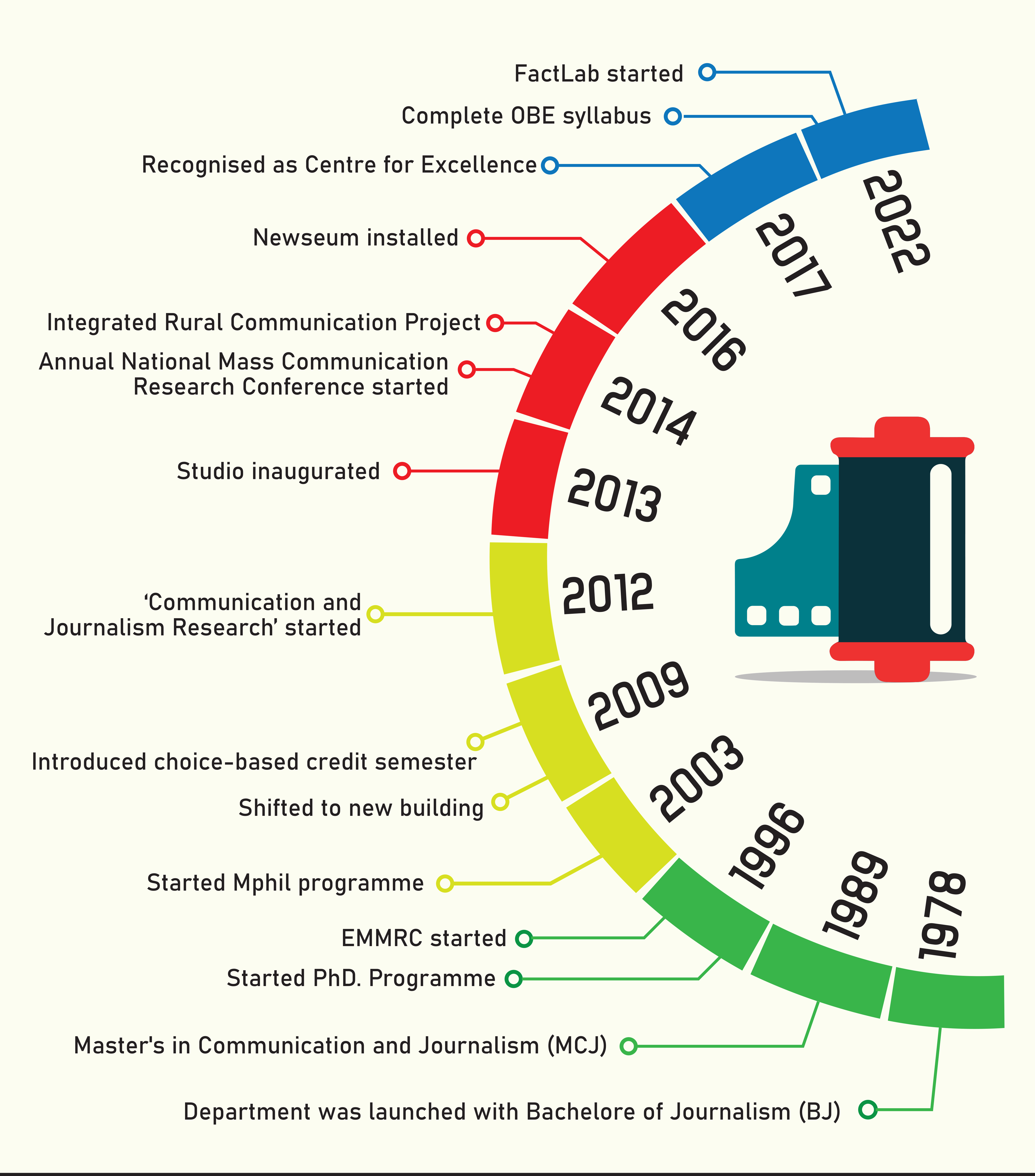
For Indian Press, the Emergency was a period of torment and torture; many newspapers and journalists ‘crawled when they were asked to bend’, many quit the field when failed to uphold media ethics, and some others opted for crazy ways to express themselves protecting the spirit of freedom of expression. In Kerala too, journalists and social activists were jailed, newspapers were ruthlessly censored or unkindly forced to shutdown. But surprisingly, it was during this period of darkness that the Government of Kerala, then led by those who supported the Emergency, decided to launch media education in the universities in the state. As a result, the University of Calicut set up the Department of Journalism in 1977 and launched Bachelor degree in Journalism (BJ) in 1978. During the same period, Masters in Journalism was started in the University of Kerala.
Early Days
In 1977, the University of Calicut invited Maxwell Fernandez, a native of Cochin who completed his journalism education at Mysore University, to head the Department of Journalism here. He started the preliminary works for setting up the Department of Journalism, but, before launching the programme he left for the University of Kerala to start PG programme there. Later, he quit the University of Kerala also to work in the media industry. He served Indian Express and the Week as a reporter and Kerala Times as an editorial coordinator.
After Maxwell Fernandez, Prof. M R Dua from Indian Institute of Mass Communication, New Delhi joined the University of Calicut. It was Prof. Dua who launched the first BJ batch in June 1978. Soon after the beginning of the programme Prof. Syed Amjed Ahmed and Prof. C.D. Chakkappan joined the department as faculty members. Later Prof. Subhash Kuttan also joined the trio.
Prof. Dua admitted 10 students- four girls and six boys; nine of them successfully completed the one-year course. Former deputy director of Doordarshan T Chamiyar and well-known journalist the late K. Jayachandran were among the students of the first batch.
“During those days, the department had the facilities like Press Trust of India wire service for news gathering and darkroom facility for photo processing. We started University Chronicle with RNI registration as lab newspaper. Printed at the University press, the Chronicle was distributed on the campus. The university community accepted it as its official organ. Most of the students of the first batch were employed in Indian and foreign media just after the course was completed”, T. Chamiyar recalls.
Launching MCJ
Prof. Dua, who was on deputation from IMMC, New Delhi, left the department after two years of service handing over the headship to Prof. Syed Amjed Ahmed. A well-known communication scholar in India, Prof. Amjed Ahmed had his MS in Communication from Bangalore University and worked as a researcher with the prestigious SITE experiment. As a faculty member, he first joined the University of Kerala and then moved to Calicut. After ten years of its successful journey with Bachelor degree in Journalism, Prof. Ahmed launched Masters of Communication and Journalism (MCJ) in 1987 with more facilities and faculty members. Dr Sucheta Nair, who worked at Government Arts and Science College, Calicut as a lecturer joined the department. During the same period, Prof. Sasibhooshanan Nair, who was working as a lecturer at the department of Journalism at University of Kerala, also joined the department as reader. After adding ‘Mass Communication’ to the programme nomenclature, the name of the department was changed from Department of Journalism to Department Journalism and Mass Communication. In 1996, the Department started registration for PhD under the guidance of Prof. Syed Amjed Ahmed and Prof. C.D.Chakkappan.
Birth of EMMRC
In 1996-97, the department submitted a detailed project proposal to the government of India to start Audio Visual Communication Research Centre (AVRC). The objective of the centre was to promote educational communication through visual media. The government approved the proposal and started the centre, first of its kind in Kerala, with Prof. Syed Amjed Ahmed as director. Later AVRC was renamed as Educational Multimedia Research Centre (EMMRC). Under Prof. Ahmed, EMMRC bagged many national and state awards for best educational documentaries.
Line up of Heads
Prof. Amjed handed over the headship to Prof. C.D.Chakkappan who led the department till 2005. Prof. Chakkappan specialized in parliamentary reporting secured his masters and research degrees from Mysore University. He led the department for ten years. It was during his tenure the department launched MPhil programme in journalism.
Meanwhile, Dr. Subhash Kuttan joined the University of Kerala as a professor of Journalism after his 25 years of academic service at the department.
After the retirement of Prof. Chakkappan, Prof. Sashibooshanan Nair headed the department for four years. During his tenure, Prof. Sasibhooshanan, who won national film award for best documentary, paid attention to enhance the facilities for visual media production. He also took initial steps to construct a new building for the department.
Dr. Sucheta Nair, who later became the Pro Vice Chancellor of Sri Sankaracharya Sanskrit University, Kalady, assumed the charge of the head of the department in 2009. During her tenure the department was shifted to the new block at the western side of the campus. Prof. Anwar Jahan Zuberi, the then Vice Chancellor of the University, was instrumental in facilitating the department with new building.
From 2010 to 2022, Dr. Muhammadali N, who secured his masters and PhD in journalism from the department, headed the department. In 2022 Dr.Lakshmi Pradeep took charge and has been heading the department.